Category Archives: Uncategorized

Residential Water Bill Example

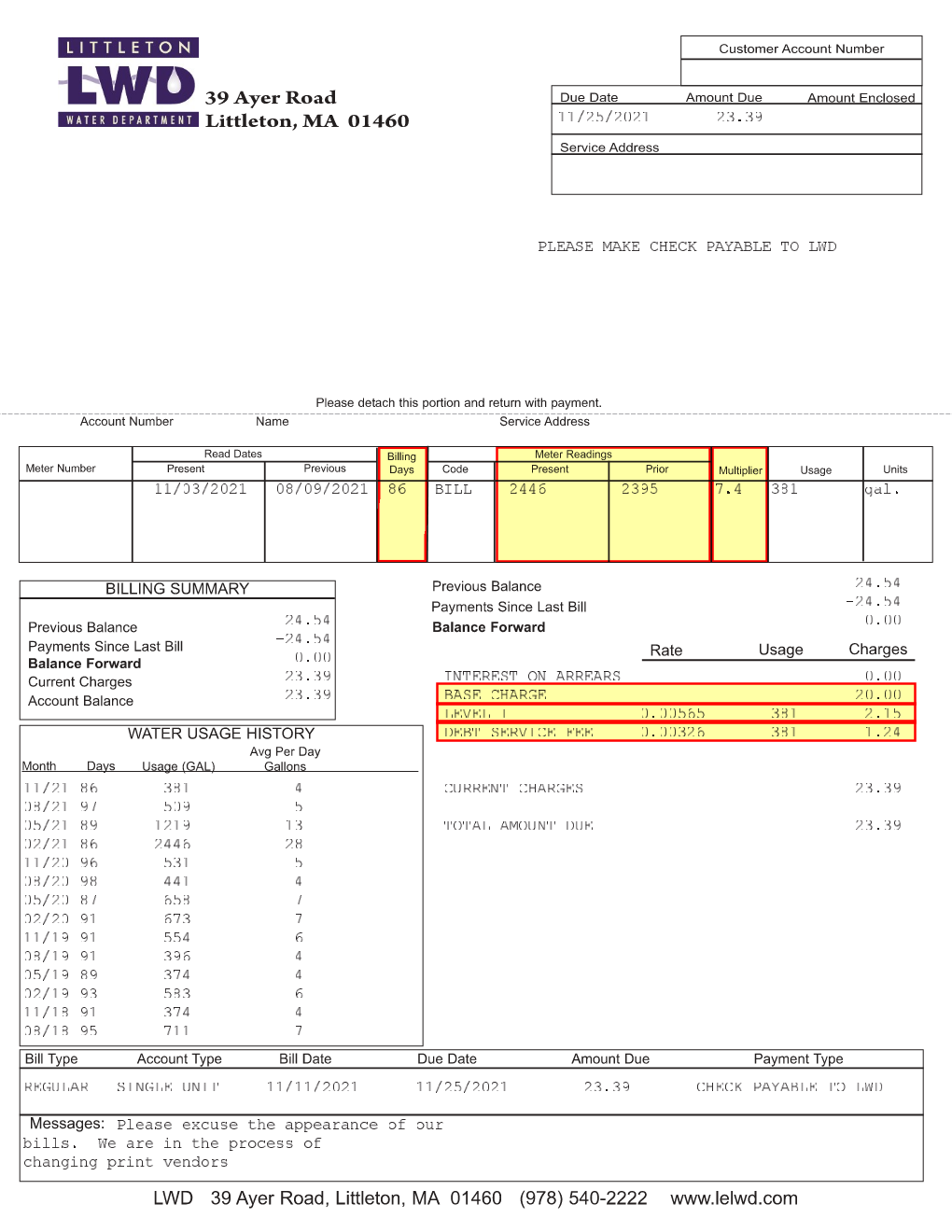
Hover over highlighted areas on the sample water bill for more information,

Residential Water Bill

Debt Service Fee The debt service fee is collected to pay off loans that financed the construction of water infrastructure projects. The fee is calculated by multiplying 0.00326 per gallon by the total gallons used.

The debt service fee is collected to pay off loans that financed the construction of water infrastructure projects.  The fee is calculated by multiplying 0.00326 per gallon by the total gallons used.


Level 1

Level 1 is the water rate for usage under 5,000 gallons per month. Once usage exceeds 5,000 gallons in any given month, usage will be billed according to an ascending block rate.

Base Charge

The base charge is a flat rate of $20 and is a universal charge every resident receives, unless you are a senior (62 & older) or handicap. 

Billing Days

Customers are billed on a quarterly basis.

Meter Readings

Meter Reads are read in cubic feet and are calculated by the difference in your previous usage reading and your present usage reading. [(Prior – Present) * (Multiplier) = Usage]

Multiplier

Multiplier is used to convert meter readings from cubic feet to gallons. The multiplier is 7.48

[(Prior – Present) * (Multiplier) = Usage]


Water Rates

Conserve to Save

Homeowners and businesses can lower their water bills by reducing the amount used. We urge our customers to conserve water not only as a precious natural resource, but also to reduce their bills.

Check for leaks in your plumbing and irrigation systems. A leaky toilet can double total usage over three months. Lawn irrigation systems can be the source of leaks that go unnoticed because they are outside the home. Use a smart irrigation controller and do not overwater.

Senior Citizen and Disabled Customer Discounts

The base customer charge is credited $3.50 for senior citizens (age 62 and over) and people with disabilities. Please call to let us know if you fall within either of these categories and we will gladly apply the credit to your monthly bill.

Water Rates

Water Rates are set by the Board of Commissioners to reflect the true cost of providing service to customers. Please see our rate schedules, charges, fees, and services as of July 1st, 2025 below.


Meter Size                                                FY26 Rate 

    • 5/8″                                        $7.00 /month
    • 3/4″                                        $7.00 /month
    • 1″                                            $17.00 /month
    • 1.5″                                         $33.00 /month
    • 2″                                            $53.00 /month
    • 3″                                            $100.00 /month
    • 4″                                            $167.00 /month
    • 6″                                            $334.00 /month

Multi-Family Residential customers will be assessed  the 5/8″ Base Customer Charge per the number of units in the building.

Water usage is billed in thousands of gallons per month, according to an ascending block rate schedule.                           

Usage (gallons)                                                FY26 Rate (per 1,000 gallons)

    • Level 1    0 – 5,000                                      $6.09
    • Level 2    5,001 – 10,000                            $7.62
    • Level 3   10,001 – 15,000                           $9.52
    • Level 4   15,001 – 20,000                           $11.83
    • Level 5    20,001 – 25,000                          $14.80
    • Level 6    >25,000                                        $18.50

Multi-Family Residential customers will be billed the Water Usage Charge based on a unit averaging methodology. The total consumption for the building will be divided by the number of units in the building, arriving  at per unit monthly consumption. The per unit monthly consumption will then be used to calculate a per unit Water Usage Charge bill based on the ascending block rate schedule. The per unit Water Usage Charge bill will then be multiplied by the number of units in the building to arrive at an aggregate Water Usage Charge bill.

For all Rate Classes

Usage (gallons)                                                FY26 Rate (per 1,000 gallons)

All usage                                                            $6.27


        1.  

$25.00

Final Bill Charge is waived for Senior Citizens


        1.  

Deposit Charge:

 1″ Hydrant Meter         $500
3″ Hydrant Meter         $2,000


Installation Charge:

 1″ Hydrant Meter         $125
3″ Hydrant Meter         $250


Base Customer Charge:

 1″ Hydrant Meter         $25.00 per month
3″ Hydrant Meter         $50.00 per month


Water Usage Charge:
Water usage is billed in thousands of gallons per month, according to an ascending block rate schedule.     

Usage (gallons)                                    FY26 Rate (per 1,000 gallons)

All usage                                       $14.80


Debt Service Charge:

Usage (gallons)                                     FY26 Rate (per 1,000 gallons)

All usage                                      $6.27

        1.  

Base Customer Charge:

 $7.00 per month


Water Usage Charge:
Water usage is billed in thousands of gallons per month, according to an ascending block rate schedule.     

Usage (gallons)                                    FY26 Rate (per 1,000 gallons)

All usage                                       $7.62


Debt Service Charge:

Usage (gallons)                                     FY26 Rate (per 1,000 gallons)

All usage                                      $6.27

        1.  

Fees and Services

The debt service fee is collected to pay off loans that financed the construction of water infrastructure projects. The debt service fee is separated from the water rates to show customers how much they pay to operate the water system versus how much they contribute to capital improvements.

The debt service fee is calculated by multiplying monthly usage by 6.27. For example, the average 4,518 gallons per month results in a debt service fee of $25.93.

Learn More..

The backflow testing charge is $75.00 for Reduced Pressure Zone (RPZ) and $125.00 for Dual Check Valves and Pressure Vacuum Breakers (PVB). RPZ devices must be tested semi-annually and Dual Check Valves annually. There is an additional charge of $75.00 for any backflow device which fails and is not repaired within 10 business days and retested.

Under 310 CMR 22.22(3)(m), each PWS is required to notify the owner of the premises of any violation of 310 CMR 22.22, such as failure to install protection, failure to maintain a device, and failure to meet testing requirements, by sending a written Notification of Violation. Any violation of the measure in Article 2.9 shall be liable to the Littleton Water Department as listed below. Each Violation will be assessed in accordance with the requirements of the cross-connection control distribution system protecting program plan (CCCPP) approved by the DEP, or in 310 CMR 22.22: Cross Connections Distribution System Protection.

1st Violation          Written Warning

2nd Violation         $50 fine and Second Written Warning

3rd Violation          $200 fine

4th Violation          $400 fine and Termination of Service

The flow testing charge is $100 per test, plus labor. Flow testing is done, per appointment, Monday through Wednesday between the hours of 10:00 p.m. and 11:00 p.m. only. Appointment requests must be made to LWD with three business days’ notice. Hydrants are to be operated by Water Department personnel only.

The fee for the operator’s time to turn a customer’s water outside of normal operating hours (Monday through Thursday, 6:30 A.M. to 4:30 P.M.) is $500.

The fee for unlawfully and intentionally altering or damaging a water meter is three times the cost of the meter plus a damage fee of  $500.

Any person violating the Water Supply Conservation measures shall be liable to the Littleton Water Department as listed below. Each day of violation shall constitute a separate offence.

1st Violation          Written Warning

2nd Violation         $50 fine and Second Written Warning

3rd Violation          $200 fine

4th Violation          $400 fine and Termination of Service

A sprinkler demand charge is billed quarterly or monthly and is based on the fire service size.

Pipe Size

Yearly Fee

Up to 2”

$862.50

3” and 4”

$1,150.00

6”

$2,300.00

8”

$4,600.00

10”

$5,750.00

12”

$6,900.00


The tapping fee covers all costs associated with the material, labor and equipment, as well as heat sealing as required by the Littleton Highway Department, used for installing the necessary piping from the Littleton Water Department’s distribution system (up to 1″) to the applicant(s) property line at the prevailing rates. It is the responsibility of the applicant(s) or the applicant(s) contractor to install the water service from the property line to the applicant(s) structure according to the Littleton Water Department’s specifications.

It is the responsibility of and at the cost of the applicant and/or contractor to install water mains greater than 1” from the existing main to the building.

The cross connection survey fee is $250.

A $100 fee is assessed for file searches and copying of environmental assessments, other large documents and the use of the department’s GIS maps.

Manual Water Read (monthly)                                                              $25.00

Removal of the AMI Meter and Installation of Non-AMI Meter       $100.00

Re-Installation of AMI Meter                                                                 $100.00

More information on Advanced Metering Infrastructure

The connection fee is a one-time charge for connecting to the distribution system and must accompany the New Water Service Application. The fee is assessed according to the actual size of the service applied for, or the number of dwelling units (whichever is higher). The fee includes a one inch meter. Anything larger than a one-inch meter will be charged to the applicant. Water service installation costs including but not limited to material, labor, and equipment are not covered by the water service application fee and are the responsibility of the applicant.

Pipe Size

Fee (domestic service pipe)

1”

$7,565

1 ½”

$17,021

2”

$30,260

3”

$68,086

4”

$121,042

6”

$272,344

Multi-dwelling
(per apt. or living unit)

$3,783

MeterConnection

Fee

5/8”

3/4”$375.00

3/4”

1”$425.00

> 3/4”

> 1”$500.00

A $15 fee per submeter per month is assessed for the reading and issuance of water bills “care of” the property owner’s tenant(s).

The annual permit application fee to become a Licensed Utility Installer (LUI) for the Littleton Water Department: $100

The annual fee must be paid by January 1st of each year.

The annual permit Bond value which must be posted: $5,000

The Certificate of Insurance to be provided must cover:

  1. General Liability:   
      • $500,000 – Property Damage
      • $500,000 – $1,000,000 Bodily Injury
  2. Automotive:
      • $500,000 – Property Damage
      • $500,000 – $1,000,000 Bodily Injury
  3. Workman’s Compensation and Employer’s Liability as required under Massachusetts General Laws.
  4. Insurance shall include coverage for collapse and underground structures.
  5. Insurance shall include coverage for projects completed operations.

All of the above insurance coverage shall remain in full force and effect for a period of one (1) year from the date of acceptance by the Littleton Water Department of the last service connection installed by the LUI. The LUI shall take all responsibility for the work and take all precaution for preventing injuries to persons and property in or around the work.

The permit bond shall be duly executed by the Principal of the LUI and by a Surety Company qualified to do business under the laws of the Commonwealth of Massachusetts and satisfactory to the General Manager.


Sewer Public Forum

Sewer Public Forum

Join us on November 19th, 2024 at 6:00 PM Eastern in the Sewer Public Forum.

The forum will take place at Littleton Police Headquarters, 500 Great Road and virtually.

Please register for the webinar by following the link below to join virtually.

After registering, you will receive a confirmation email containing information about joining the webinar.


Phone Scam Warning

Please be aware of telephone scams.  LELWD will never seek immediate payment over the phone using a prepaid debit card or money order. LELWD does not contract with Eversource or another utility on service shut offs. If called about an instant payment or service disconnection, immediately hang up and call LELWD to verify your account status at 978-540-2222, Mon.-Thurs., 6:30 a.m. – 4:30 p.m.

If you would like to contact the Federal Trade Commission:

By phone – 877-382-4357

FTC Website – https://www.ftc.gov/faq/consumer-protection/submit-consumer-complaint-ftc

LELWD scam warning letter

Cedar Hill Water Tank

Cedar Hill Tank Project

Enter your email below to receive updates only when new content is added to this page*

WATER TANK DEMOLITION

Updated October 26th, 2023

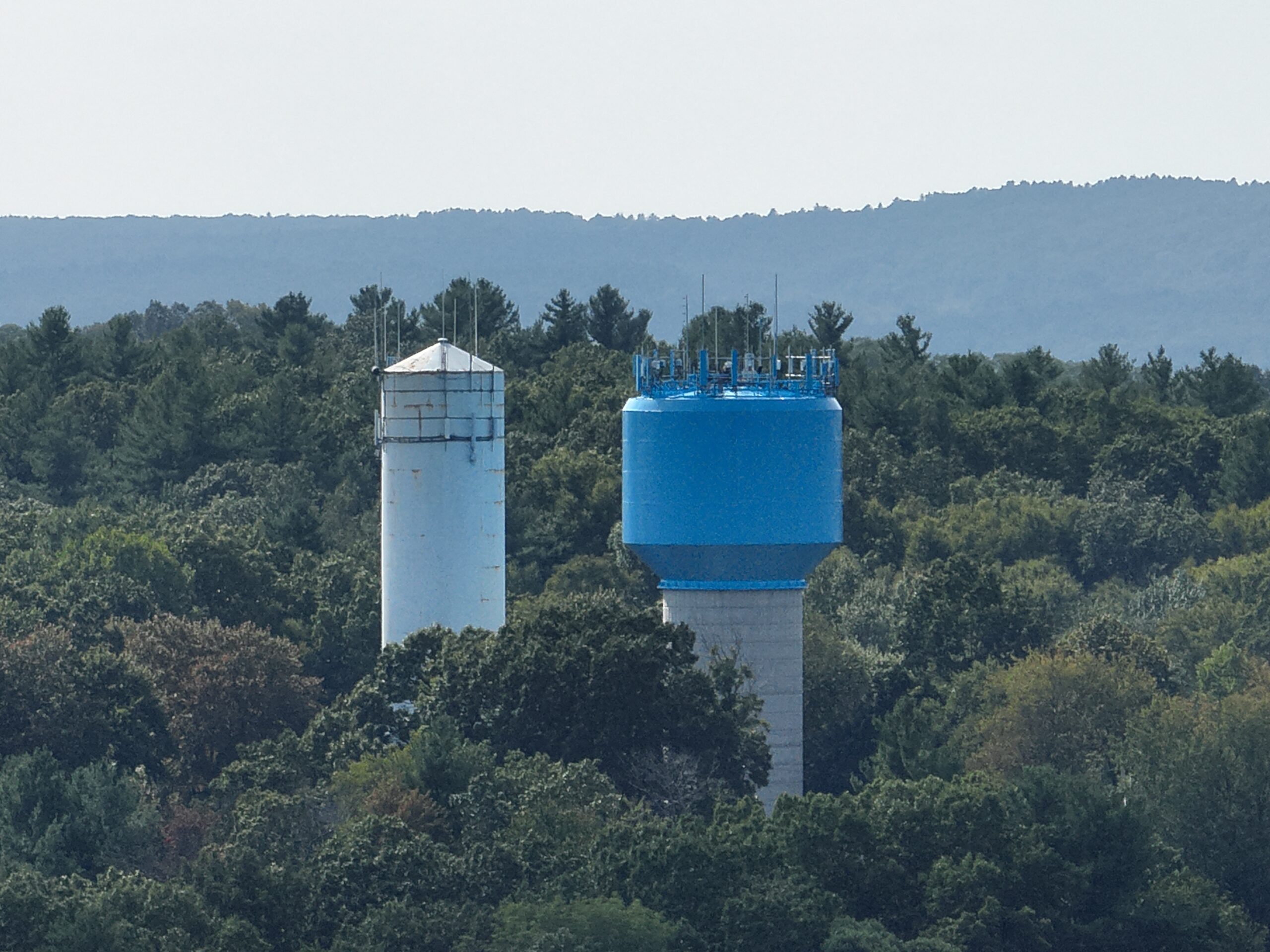
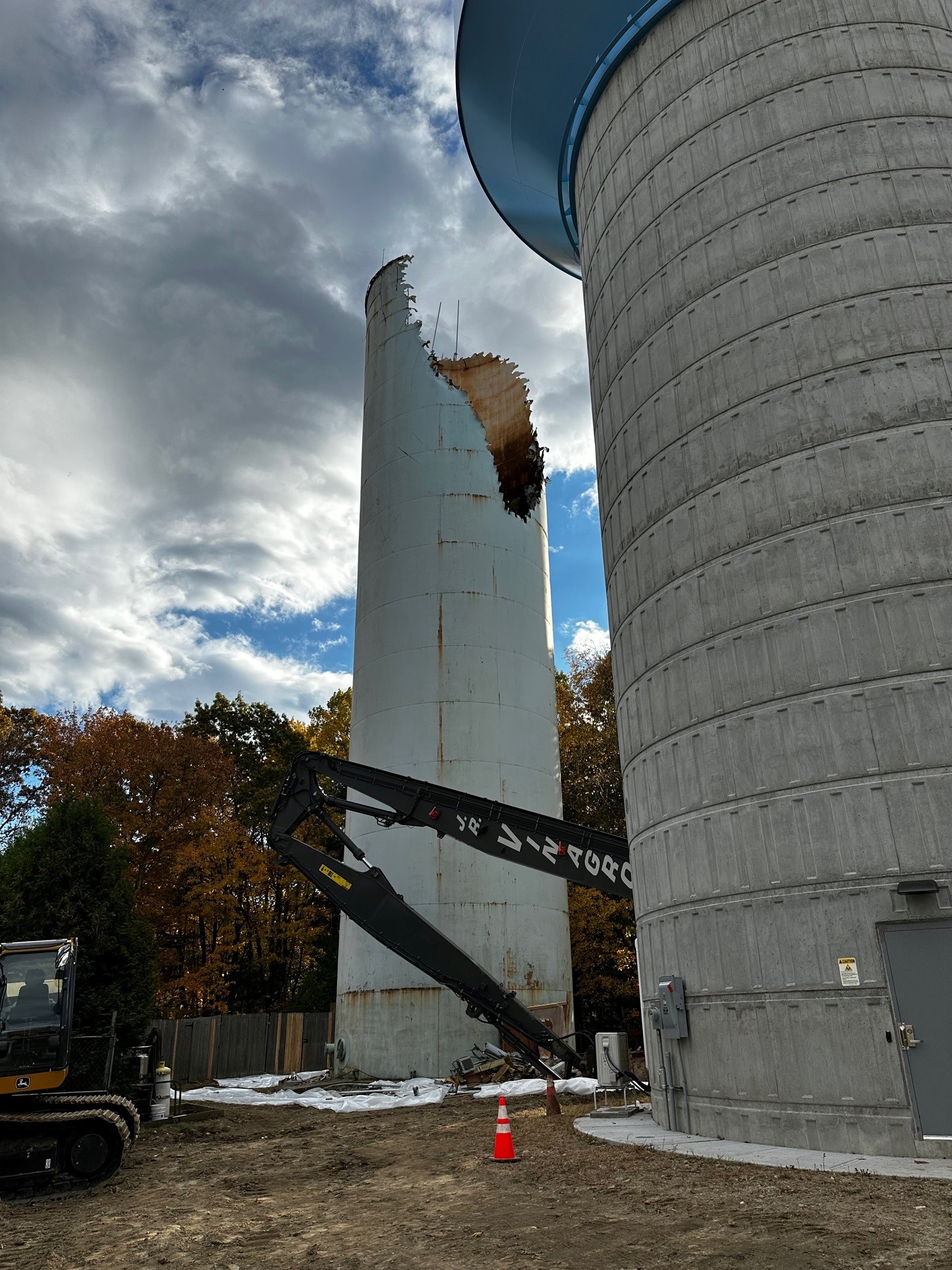
The demolition of the old Cedar Hill Water Tank started October 23, 2023, and is scheduled to take up to four weeks to complete. The work is scheduled to occur weekdays, between 7 a.m. and 3:30 p.m. The work involves cutting the steel tank and dropping the pieces to the ground. Please anticipate loud noises and an unsightly worksite until the project is completed.

Work completed as of today:

    • Old cellular antenna equipment has been removed from the top of the tank.
    • The shed at the front of the tank was demolished.
    • The top of the tank has been removed.

Up next:

    • The large excavator with a 120-foot boom and revolving shear will cut the tank down in pieces.
    • Once enough of the tank has been demolished, the steel pieces and waste materials will start to be removed from the site.
    • After the tank has been removed, the tank foundation will be removed and the hole backfilled.
    • The final step will be site grading and fence installation.

We are grateful to the residents who are impacted by this project, and we thank them for their patience and understanding as we constructed a new water tank to maintain the system infrastructure. The new tank is completed and in use.

Starting in early December, work will begin on constructing the metal water tank. Please see the “Cedar Hill Neighborhood Letter November 2021″ for more details.

Construction of a new water tank on Cedar Road is planned to begin on June 7th. Please see the “Cedar Hill Neighborhood Letter June 2021″ for more details.

Thank you for joining us on September 23rd, 2020 at 7:00 PM Eastern to learn more on the Cedar Hill Water Tank Project. 

The Littleton Water Department has begun the process of replacing the existing water storage tank on Cedar Road with a NEW Storage Tank which will be constructed on the parcel abutting the existing water tank parcel (34 Cedar Road). The first step in this process was retaining the services of Tata & Howard, Inc. for the design and construction oversight of the New Cedar Hill Water Tank.  Over the next several weeks you may notice some activity taking place at or near the existing tank site, as survey and soil borings are undertaken to assist in the design and layout of the new tank.  The Littleton Water Department, along with Tata & Howard, plans on hosting an information session with abutters sometime after the New Year to present the plan and take questions from abutters. 

Georgetown Water Tank

A few facts about the project: 

  • The existing water storage tank was constructed in 1950 and holds approximately 485,000 gallons of water.
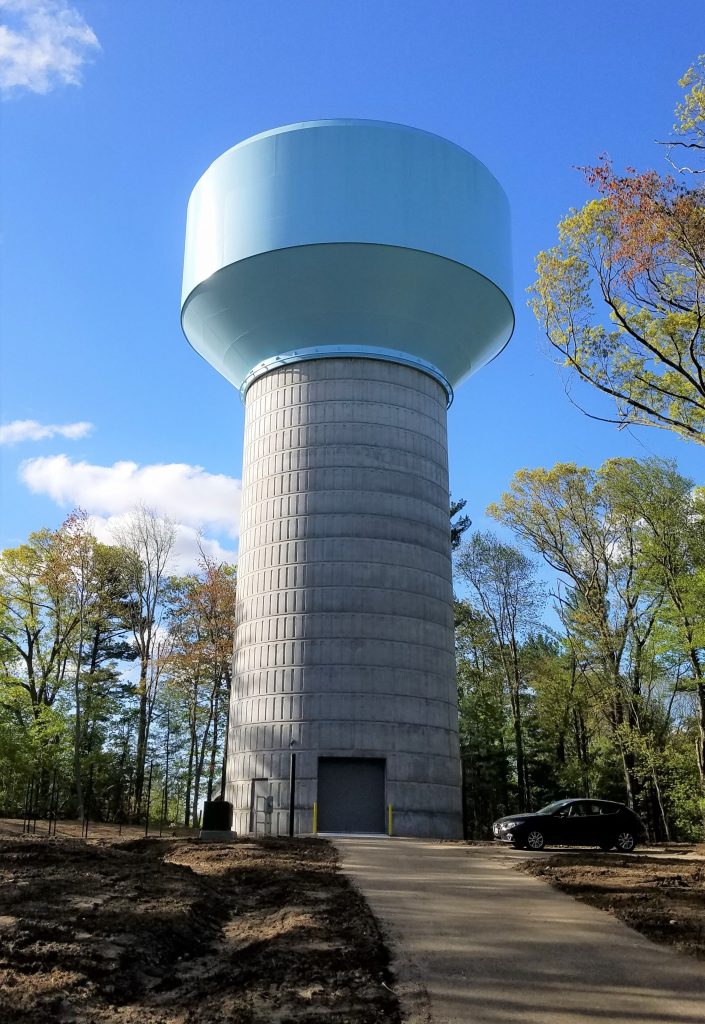
  • Similar to the Georgetown Water tank photo above, the new tank design will be a composite concrete pedestal and steel tank with similar volume as our current tank on Cedar Hill.
  • The existing Cedar Hill Tank is critical to LWD’s ability to meet the daily demand of our customers, as well as maintain proper pressure in the Long Lake neighborhood.  Therefore, it will be necessary to keep the existing tank in service while the new tank is constructed. 
  • Once the NEW Storage Tank is completed and in service, the existing storage tank will be removed and the site restored. 

This page will be updated as more information becomes available.

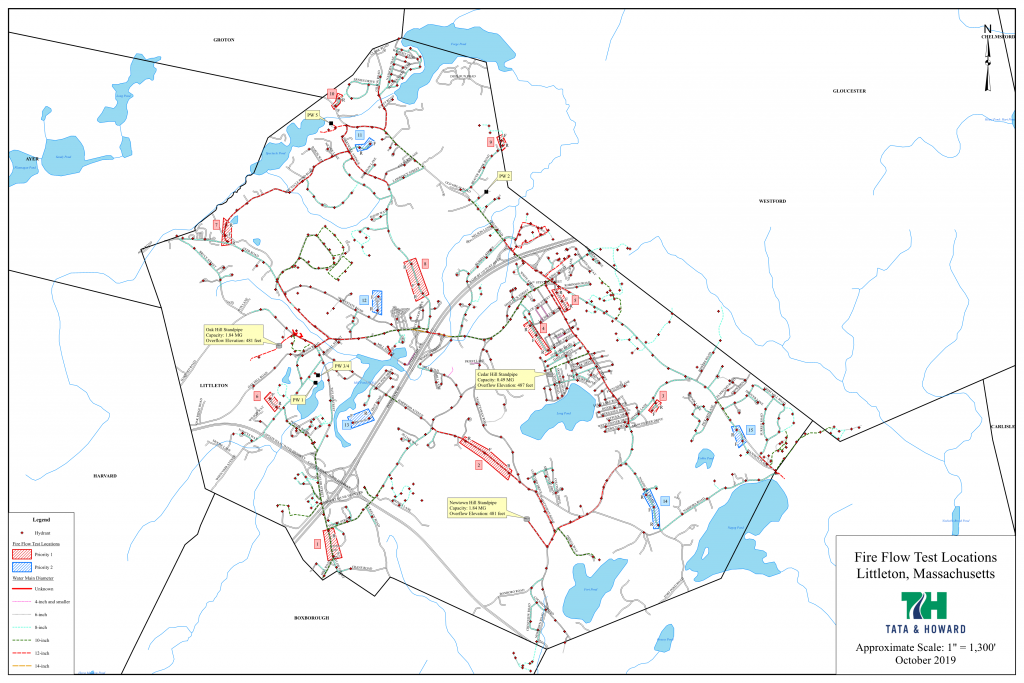
Fire Flow Testing & Hydrant Flushing

Testing fire flows and hydrant flushing requires opening fire hydrants and releasing large volumes of water. This is regular maintenance conducted by all water systems.

Pros: The flow tests ensure adequate water pressure to fire hydrants for fire protection.  The flushing of the water mains removes sediment that can build up and restrict water flow, reducing water pressure.

Con: This system maintenance can result in temporarily discolored water which may last 24-48 hours.  While the water remains safe, it has an unappetizing appearance.  It can also stain laundry and fixtures.

What Should You Do?

  • Prior to the designated flushing period: consider collecting water in a pitcher or pot to be used for drinking and cooking over the next 24 hours.
  • In the 24 hours after flushing, reduce usage as much as possible to avoid drawing discolored water into your home piping.
  • Avoid using laundry, ice machines, dishwasher, bathtubs, or hot water tanks.
  • If your water still appears discolored after 24 hours, run a cold water tap closest to your meter (usually found in the basement or a first floor sink) for up to 15 minutes.
  • If the water coming from the tap is not clear after running for 15 minutes, wait 1-2 hours and try again.
  • Avoid running a hot water tap because it could draw sediment into your hot water tank.

If you inadvertently drew discolored water into your home and the staining of clothes or fixtures does occur, rust removal products are available at the LELWD office..

Protected: Auto Draft

This content is password protected. To view it please enter your password below:

Hydrant Flow Testing

Hydrant Flow Testing will take place on Monday October 21st, Tuesday October 22nd and Wednesday October 23rd

The Littleton Water Department will be conducting Hydrant Flow Testing   As a result of the tests, it is likely that you may experience some discolored water in the hours after 10 pm.  LWD recommends you avoid washing clothes and limit water use during the overnight period.  There may be some residual discoloration in the morning hours as well, but it is expected that water quality will improve quickly thereafter.  LWD conducts these tests at night to limit the interruption to our customers, and the information gathered is critical in assisting LWD in planning and design of system upgrades.  We appreciate your understanding.   

Areas impacted will receive an automated call on the community notification system. If you are not enrolled or unsure, visit https://public.coderedweb.com/CNE/en-US/458D14D27696 to enroll.

Important Information for all consumers receiving Drinking Water from our system

— Translate it or speak with someone who understands it — Translations are on the PDF Version.

Important Notice: This notice provides important information regarding your drinking water and contaminants known as Per- and Polyfluoroalkyl Substances (PFAS). Although the most recent sampling results for Littleton Water Department showed PFAS in the drinking water, the results were below the current health guideline established by the United States Environmental Protection Agency (EPA) and Massachusetts Department of Environmental Protection (MassDEP). This notice provides information about MassDEP’s ongoing efforts to address PFAS in drinking water and provide health-protective guidelines.

The EPA in 2016 published a drinking water Health Advisory Level for two of the PFAS compounds (Perfluorooctanesulfonic acid, PFOS, and Perfluoroocatanoic acid, PFOA) combined at 0.070 micrograms per liter (ug/L) or 70 parts per trillion (ppt). In June 2018, MassDEP issued an Office of Research and Standards guideline (ORSG) for drinking water of 0.070 ug/L or 70 ppt for five PFAS compounds combined. Those compounds are PFOA (Perfluorooctanesulfonic acid), PFOS (Perfluorooctanoic acid), PFNA (Perfluorononanoic acid), PFHxS (Perfluorohexanesulfonic acid) and PFHpA (Perfluoroheptanoic acid). The ORSG was established to be protective against adverse health effects for all people consuming the water for a lifetime and is also applicable to shorter-term exposures of weeks to months during pregnancy and breast-feeding.

Based on the current ORSG, MassDEP has recommended that:

  1. consumers in sensitive subgroups (pregnant women, nursing mothers and infants) not consume water when the level of the five PFAS substances, individually or in combination, is above 70 ppt; and,
  2. public water suppliers take steps expeditiously to lower levels of the five PFAS, individually or in combination, to below 70 ppt for all consumers.

As part of the agency’s efforts to address PFAS compounds, MassDEP continues to review the current scientific information, studies and assessments on PFAS and based on this evaluation, MassDEP is undertaking the following actions:

  1. MassDEP proposed draft amendments to the Massachusetts hazardous waste cleanup regulations (the Massachusetts Contingency Plan or “MCP”) that include groundwater and soil cleanup standards. Consistent with the proposed ORSG level described below, the proposed standard for groundwater that is currently used or could be used as drinking water is 20 ppt for the five compounds noted above plus PFDA (Perfluorodecanoic acid) (six total).
  • MassDEP’s Office of Research and Standards has convened its Health Effects Advisory Committee to provide input on the technical basis of the proposed MCP standards and its implication for a potential revised ORSG with a limit of 20 ppt for the sum of the six PFAS compounds.
  • MassDEP also recently began the process to develop a drinking water standard for public drinking water systems, known as a Maximum Contaminant Level (MCL), for the six PFAS compounds combined. Information on this effort, including information on stakeholder meetings, can be found at https://www.mass.gov/lists/development-of-a-pfas-drinking-water-standard-mcl.

What PFAS Levels have been detected in your drinking water, and what should you do?

Samples collected at the Spectacle Pond Water Treatment Plant on June 19, 2019 and confirmed on August 6, 2019 showed an average total of 25 ppt for the following six PFAS: PFOA, PFOS, PFNA, PFHxS, PFHpA, and PFDA.

  • These results are below EPA’s and MassDEP’s current health advisory guidelines but they are above the new 20 ppt guideline now under consideration by MassDEP. If you are a sensitive consumer (pregnant women, nursing mothers, and infants) you can minimize your exposure by using bottled water that has been tested for PFAS for drinking, making infant formula and cooking foods that absorb water or use a home water treatment system that is certified to remove PFAS by an independent testing group such as NSF International, Underwriters Laboratories, Water Quality Association, or the CSA Group. See MassDEP PFAS Factsheet for more information at https://www.mass.gov/info-details/per-and-polyfluoroalkyl-substances-pfas
  • Boiling water will not destroy PFAS and will somewhat increase their levels due to evaporation of some of the water.
  • As PFAS compounds are not well absorbed through the skin, you may safely use the water for bathing and showering. If you are concerned about your exposure, even though the risk is very low, you may want to use bottled water for brushing your teeth and cleaning items like dentures, pacifiers, and fruits and vegetables.
  • If you have specific health concerns regarding your exposure, you may want to consult a health professional, such as your doctor.

What is our water system doing?

Our system has taken the following actions:

  • Littleton Water Department is minimizing usage of the source with elevated PFAS levels (Spectacle Pond).
  • We are investigating alternative sources of water and treatment options.
  • Littleton Water Department’s other wells did not contain any combination of the six PFAS above 20 ppt.
  • We will continue to sample our water source for PFAS on a quarterly basis.
  • We are working as expeditiously as possible to install treatment to remove the PFAS from Spectacle Pond drinking water.
  • We are exploring interconnections with other public water systems to purchase drinking water.
  • We are also investigating the source of the PFAS with assistance from MassDEP.

What are PFAS and how are people exposed to them?

PFAS are fluorinated organic chemicals. Two PFAS chemicals, PFOA and PFOS (perfluorooctanoic acid and perfluorooctanesulfonic acid) have been the most extensively produced and studied of these chemicals. PFAS are contained in firefighting foams, which have been used in training exercises and to extinguish oil and gas fires at a variety of locations including airfields and military installations. PFAS are also used in a number of industrial processes and have been used to manufacture carpets, clothing, fabrics for furniture, paper packaging for food and other materials (e.g., nonstick cookware) that are resistant to water, grease or stains. Because these chemicals have been used in many consumer products, most people have been exposed to them.

While consumer products and food are the largest source of exposure to these chemicals for most people, drinking water can be an additional source of exposure in communities where these chemicals have contaminated water supplies. Such contamination is typically localized and associated with a specific facility, for example, an airfield at which they were used for firefighting or a facility where these chemicals were produced or used.

Where can I get more information?

For more information on what our system is doing about this situation, please contact Corey Godfrey at 978-540-2282, [email protected], or 39 Ayer Road, Littleton.

You can also get more information on PFAS from the following sources:

Please share this information with all the other people who drink this water, especially those who may not have received this notice directly (for example, people in apartments, nursing homes, schools, and businesses). You can do this by posting this notice in a public place or distributing copies by hand or mail.

This notice is being sent to you by:

PWS Name: Littleton Water Department PWS ID#: 2158000

Date distributed: October 21, 2019

A Letter to LWD Customers About PFAS

August 1st, 2019

Dear Customers:

We are closely following communities west of Littleton where a family of chemicals called per- and polyfluoroalkyl substances, or PFAS, have recently been found at levels exceeding EPA and MassDEP guidance values. While there is currently no state or federal standard, the EPA and MassDEP recommend that PFAS concentrations in drinking water not exceed 70 parts per trillion (ppt).

LWD voluntarily tested our three well sites for the presence of PFAS and the results showed all three locations were under the current federal and state guidance values. Littleton’s water continues to meet all the federal and state guidelines for safe drinking water.

Nonetheless, LWD is looking into options to increase treatment of the water from the Spectacle Pond well site where test results, received Monday, showed PFAS levels at 28 parts per trillion (ppt). While substantially below the current 70 parts per trillion (ppt) guideline, LWD is conducting further testing to monitor and validate the data, and we have started analyzing options for installing treatment equipment to remove PFAS.

The tests showed no PFAS at the Whitcomb Avenue well sites, which provides half of the water supply. The Beaver Brook well sites tested for trace amounts of PFAS. We will continue to test for the presence of PFAS at these sites, but do not feel further action is needed at this time.

LWD has a mission to deliver clean and reliable water, and we are always concerned when manmade pollutants threaten our water supply. LWD’s immediate next steps include:

  • Ongoing communication with MassDEP for guidance and technical expertise.
  • Additional water quality testing.
  • Retaining a water quality engineering firm to develop treatment options.
  • Collaborating with the Ayer Water Department to share information and possible solutions.
  • Provide a further update to our customers by the end of this month.

If you wish to learn more about PFAS, which is an emerging issue both in Massachusetts and across the nation, visit the MassDEP website:

https://www.mass.gov/info-details/per-and-polyfluoroalkyl-substances-pfas#pfas-detected-in- drinking-water-supplies-in-massachusetts-

Sincerely,

Nick Lawler General Manager

PDF version of Letter.